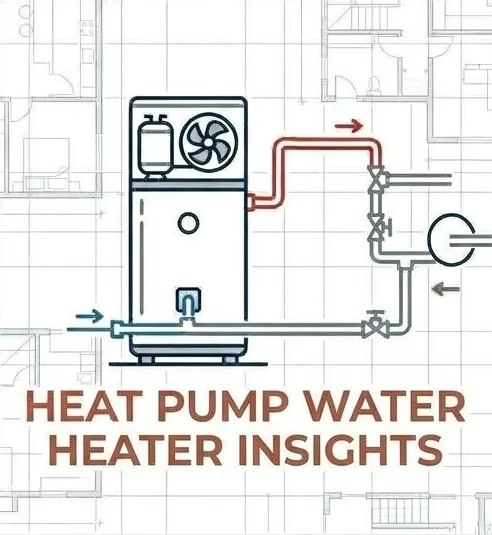
HPWH Insights · Issue 4: How the loop is kept hot decides the system's efficiency
Issue 4 · · 8 min read
From AbGarm Energy.
Good morning.
This issue is about one line on the schematic: how the hot water loop is kept hot. In lab tests, the same tank served the loop in heat pump mode and in resistance mode, and the system’s coefficient of performance (COP) fell from 1.73 to 1.05. The primary heat pump ran at almost the same efficiency in both. We also look at a survey arguing that a high metered loop loss may be cold water getting in, not heat getting out.
How the loop is kept hot decides the system’s efficiency
A central heat pump water heater plant does two jobs. It heats cold city water for the taps, and it reheats water returning lukewarm from the recirculation/distribution loop, the pipe circuit that keeps hot water near every apartment. The part of the load for keeping the loop warm is distinguished as temperature maintenance, and the designer chooses which heater covers it.
That choice seems easy to treat as a piping configuration only. But the results of a paper in the ACEEE Summer Study proceedings suggest it is among the most important design decisions. Its four tests ran at a PG&E laboratory, on three piping arrangements, each for a 24-hour test period. They used commercial unitary HPWHs to supply simulated loads for a typical small apartment building.
The first design is to use the primary HPWHs and their tanks to supply both loads. Return to primary sends the recirculation return back to the bottom of the two primary tanks. The second design uses one of the tanks, with resistive electric heaters, dedicated to the temperature maintenance load and piped in series with the primary tank. The recirculation returns to the bottom of the second tank. When there is a draw event, the primary tank, at a higher set point, charges the secondary tank and in theory reduces the need for heat delivery by that tank. The temperature maintenance tank in series downstream primary storage is called “swing tank” and is popular with HPWHs using CO2 as the working fluid. That is because CO2 HPWHs are more sensitive to the entering water temperature. Separating recirculation loads in this way will guarantee the primary heater does not experience high entering water temperatures.
The third design is to completely separate the two loads and dedicate one tank to each. The two parallel designs pipe one of the two units in parallel with the other and dedicate it to the temperature maintenance load. It ran in heat pump mode in one test and in resistance mode in the other.
The paper measures each design at three boundaries. Unit COP is the useful heat one heater delivered over the electricity it consumed, and Plant COP does the same sum for all the heaters together. Effective System COP goes furthest, “accounting for all thermal and electrical processes between the city inlet water and the point of use.” In our view, this is the real performance of the hot water system, and it catches the recirculation temperature maintenance loads as a real loss.
Where the efficiency goes: Take the parallel design with the dedicated unit in resistance mode. In its 24-hour test, the primary heat pump posted a Unit COP of 2.96. The temperature maintenance unit in resistive mode ran at 0.94, the plant came out at 1.57, and the effective system performance, from city inlet to point of use, at 1.05.
With the same design and the temperature maintenance unit set to heat pump mode, the primary heat pump ran at 2.97. The dedicated unit now ran at 2.36, the plant at 2.57, the effective system at 1.73. One unit’s heating mode moved the whole system from 1.05 to 1.73.
Effective storage, the paper’s measure of the hot water held in reserve, averaged around 90 gal in the parallel design. During peak loads it fell below 50 gal.
The parallel configuration made the best and worst plant and system performance among the tests.
Return to primary landed between them, at an Effective System COP of 1.43. Its primary heaters posted Unit COPs of 2.40 and 2.17, the lowest of any primary heater, with warm loop water now theirs to reheat.
In exchange it held the most hot water in reserve. Effective storage averaged 196 gal and never fell below 175 gal. The swing tank configuration came in at an Effective System COP of 1.29, with its heat pump at 3.15 and its resistive tank at 0.96. Its effective storage averaged 185 gal and never fell below 170 gal.
The paper reports one 24-hour result for each design and does not say whether any test was repeated. It also leaves pump energy out of every COP.
What does that mean for designers? The heat pump’s own COP describes the first boundary only. The heater that carries the loop decides how much of the heat pump’s efficiency reaches the tap.
The design of the plant as a whole decides how much of the heat pump’s efficiency reaches the tap and what effective hot water reserve is available.
In these tests, a dedicated parallel heat pump covering the temperature maintenance was the most efficient design, and a dedicated parallel resistance heater the least. Both held the least hot water in reserve. Return to primary gave up primary heat pump efficiency for the most storage. The swing tank had the most efficient heat pump and lost that advantage at its resistive tank. Which trade fits a project is a design-phase question, settled before the plant is piped.
High metered loop losses may be cold water, not heat
A survey published by CalNEXT monitored loop losses at 13 California multifamily sites. It measured distribution loss per apartment unit, a metric the Ecosizer sizing tool also uses. The report puts the sites’ averages at 24 to 99 W/apt, watts per apartment. The report declared that the recorded data “validate” Ecosizer’s assumptions: 60 W/apt for new buildings, 90 W/apt for existing ones. But digging deeper into the report, we find it does not support this claim.
What the meter may be counting: At nine sites, the report puts measured loop loss at 1.1 to 2.3 times an idealized calculation. That idealized calculation is a made-up indicator, not a calibrated model. The report’s leading suspect for the mismatch between calculation and measurement is cold-water crossover, “where pressure imbalances drive cold water into the hot distribution loop.” That, it says, “registers as inflated heat loss in metering even though no additional heat is escaping the pipes.”
How firm is that? The report itself calls its crossover figures “an upper-bound single-cause estimate.” It concedes that the results “do not prove that crossover explains the high losses seen in prior studies.” It rests on one week of monitoring per site, and calls its sample small.
Resistance on the loop, again: The report found one swing tank site where “nearly the entire 3.8 kW temperature maintenance load was being served by electric resistance.” That was before corrective action. Once the set point was lowered, resistance use “dropped substantially,” it says, though no number is printed for the drop.
What does the report recommend for swing tanks? It recommends capping the set point at 130°F and minimizing return flow to the temperature-maintenance heater. It draws that guidance from NEEA’s Advanced Water Heating Specification.
What the research shows
Across the lab and field studies we follow, one reading recurs: the temperature-maintenance load, more than equipment efficiency, decides how the whole system performs. Swing tanks stay competitive with other designs only where loop heat loss is low, as in new, well-insulated buildings. In retrofits the loss is usually higher, and the tank can end up as the main heat-supplying source.
How large is the loop loss? An earlier literature review set a wide range, and the survey above disputes what the highest readings measure.
Where the return should go is also unsettled. Our notes on the field research record one study as saying that return water should stay out of primary storage, a design it did not test. The ETCC field demonstration in THE SPEED READ below did test it.
However, designers and practitioners have more to do to figure out what the correct plant configurations are for various applications.
THE SPEED READ
- A field study that fitted digital master mixing valves, electronic valves designed for recirculation loops, at five sites estimated that they reduce water-heating energy use by 4.5% on average, though savings ranged from 11.4% to -4.9%, the -4.9% at a site with heat pump water heaters. (CalNEXT)
- A field demonstration in six multifamily buildings returned the loop to primary storage, and swing tank energy fell to 0 kWh/day in each reported comparison. In the report’s summary table, system savings ran from -1% to 12%, largest where the swing tank had used the most. They are normalized daily figures, from tests planned for about two weeks each. (ETCC)
- A laboratory report, on tests at the PG&E laboratory the featured paper used, calls the swing tank design “less risky,” always giving adequate supply water temperature but a lower System COP than returning the loop to the bottom of primary storage. (ETCC)
- A laboratory report that tested seven balancing valves on one recirculation system, built in a PG&E laboratory and modeled after a three-story multifamily building, found that average temperature at the valves followed total recirculation flow, whatever the valve model, once that flow was above 0.17 GPM per riser; it is a result from one lab system, in a report with no section on its limits. (ETCC)
- At the four multifamily buildings of a field study, all with heat pump water heaters, proportional pressure control cut metered daily pump energy by between 19% and 91% against a single-speed, unbalanced baseline, and constant return-temperature control cut it by 91% at one site; the study’s water-heater savings were calculated with an assumed COP of 2.5, not metered. (ETCC)
What to check this week
- On the piping schematic, find which heater reheats the recirculation return: resistance elements, a dedicated heat pump or the primary heat pump. That is the choice the chart compares.
- On the equipment schedule, read the set point of the swing tank or parallel temperature-maintenance tank against the primary storage set point. Tests with one ran 125°F against 140°F.
- In the energy calculation, ask which boundary each COP was taken at, and whether pump energy is in it. A unit COP says nothing about the loop.
- Before specifying new insulation for a loop whose metered loss runs well above 70 to 100 W/apt, ask whether it has been pressure tested for crossover, as the survey recommends for any building planning a retrofit.
Previously, in issue 3: multi-pass stirs the water the heat pump needs cold.
Next: issue 5 takes up the zero-NOx rules and the incentive programs that bear on when a building switches to heat pump water heating.
Sources
- ACEEE, Evaluation of Central Heat Pump Water Heater System Temperature Maintenance Methods for Multifamily Buildings (2026).
- CalNEXT, Multifamily Domestic Hot Water Recirculation Survey (2026).
- NEEA, Advanced Water Heating Specification.
- Ecotope, Literature Review of Multifamily Central Domestic Hot Water Distribution Losses (2019).
- CalNEXT, Field Study of Master Mixing Valve Energy Efficiency Potential (2024).
- ETCC, Field Demonstration Findings for Minimizing Electric Resistance Use in Multifamily and Nonresidential Heat Pump Water Heater Retrofits (2026).
- ETCC, PG&E and SCE HPWH Laboratory Testing and Software Updates for Multifamily Applications (2024).
- ETCC, Lab Testing of Balancing Valve Performance in a Multi-Family Central Recirculation System (2025).
- ETCC, Circulator Pump Controls Field Study (2026).